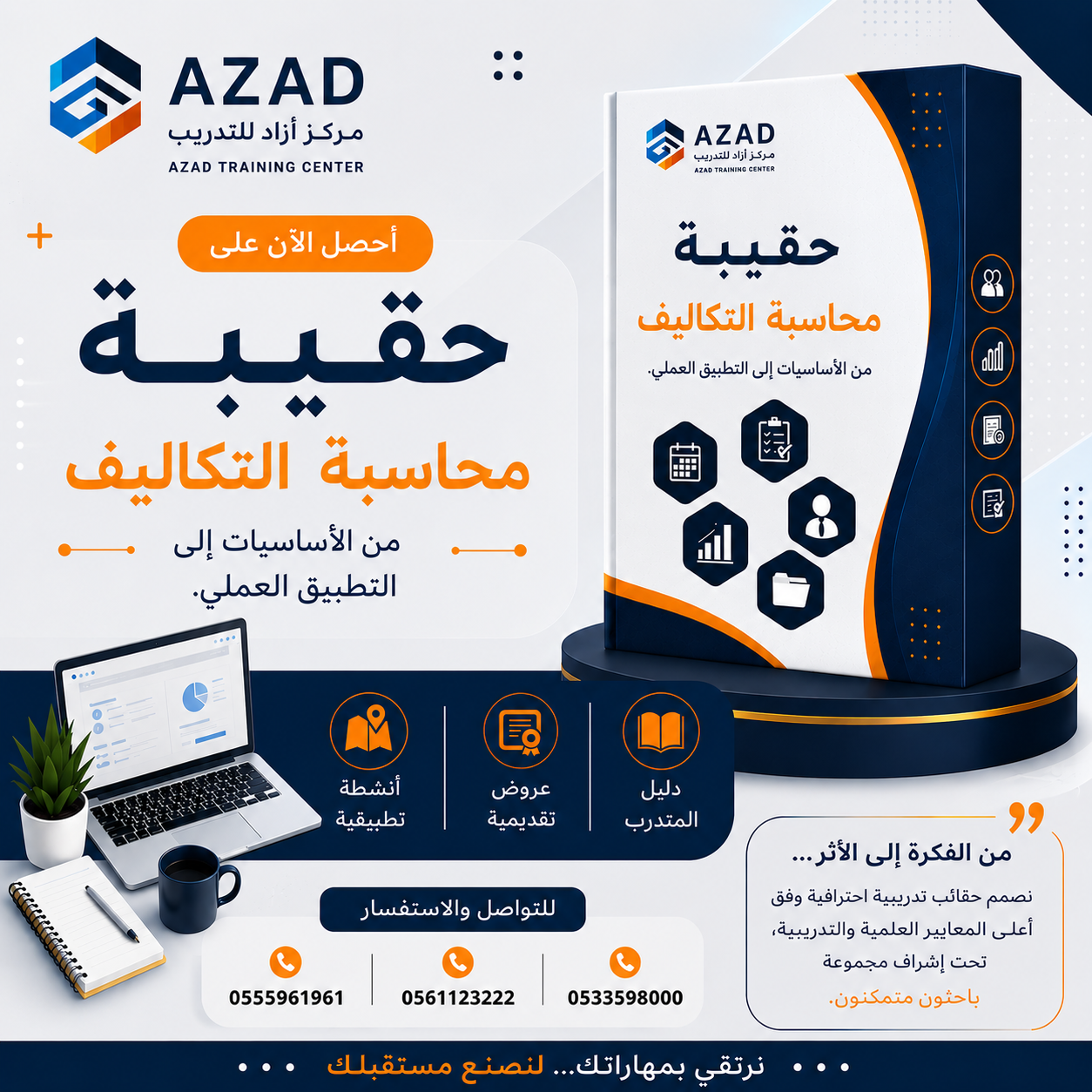
Cost accounting: from the basics to practical application.
290
500
290
VAT included
Description
Nature of the bag: Training bag, qualifying, technical, and technological, designed to qualify the trainee to perform the basic tasks of an entry-level cost accountant within industrial and service work environments, through practical applications, Excel models, digital exercises, ongoing training case, and a final cost project. Duration of the bag: 3 training days. Training method: Practical applied technical training based on practice, not a theoretical explanation of cost accounting material. Targeted group: New accountants. Recent graduates in accounting. Accounting students and graduates, and business administration. Financial accounting employees wishing to transition to the cost field. Employees in operations, production, inventory, and procurement sectors. Small project owners and entrepreneurs wishing to understand the cost of their products and services. Employees nominated to work in cost departments, financial planning, or operational control. Description of the training bag: This bag offers an applied technical qualifying program in cost accounting, aimed at enabling the trainee to perform the basic tasks of an entry-level cost accountant, starting from receiving and classifying cost data, preparing cost lists, calculating unit cost, and ending with using cost data in pricing, control, and profitability improvement. The bag relies on a practical training methodology that links accounting concepts with actual job performance within industrial and service establishments, through work models, Excel applications, operational cases, digital exercises, and a mini cost project simulating the tasks of a cost accountant in the work environment. Overall goal of the bag: Qualify the trainee technically and practically to perform the basic tasks of a cost accountant, through classifying costs, preparing lists, and analyzing cost data to support pricing, control, and decision-making. Practical tasks the bag qualifies for: Collecting cost data from materials, labor, and operations. Reading basic cost documents and linking them to activities. Correctly classifying cost items. Preparing a simplified industrial or operational cost list. Preparing a production order cost card. Preparing a cost report for a production stage. Calculating the unit cost of a product or service. Determining an appropriate allocation basis for indirect costs. Distributing indirect costs over products or services. Calculating the break-even point and contribution margin. Proposing an initial selling price based on cost and profit margin. Preparing a brief cost report directed to management. Developed training methodology: Simplified technical explanation of basic concepts. Practical training on ready-made cost models. Gradual digital exercises from simple to complex. Continuous practical case on a virtual company throughout the training days. Applications from industrial and service environments. Discussing common professional mistakes in cost classification and allocation. Final cost project measuring the trainee’s ability to apply. Pre- and post-test to measure learning impact. Practical outputs of the bag: Cost element classification model. Cost list model. Production order cost card model. Production stage cost report model. Cost centers model. Indirect cost allocation model. Unit cost calculation model. Break-even analysis model. Brief management cost report model. Final cost project file for the trainee.